

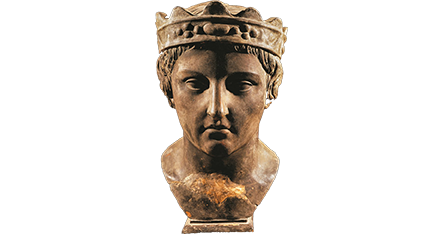
Petrus de Vinea
Epistolarum Libri VI
The Historical and Literary Importance of the Letter Collection Attributed to Petrus de Vinea
Under the now well-established title Epistolary of Pier della Vigna is designated a body of letters and texts in epistolary form that the medieval tradition transmitted under the name of the dictator Petrus de Vinea, the most renowned among the officials and notaries of Frederick II’s chancery. In reality, this is not a “correspondence” in the modern sense, nor a unified corpus conceived as an authorial collection: rather, the Epistolary is the result of a long process of sedimentation, in which documents produced or reworked within the chancery milieu flowed into epistolary collections and, above all, into collections of models for the ars dictaminis, becoming exemplary material for the teaching of the ars dictaminis in schools and universities between the thirteenth and fifteenth centuries.
The historical and literary strength of this corpus lies precisely in its hybrid nature. On the one hand, it preserves the memory of an extraordinary political and administrative laboratory: the construction of imperial authority in the Kingdom of Sicily and in the Empire, the management of relations with the papacy, the cities, territorial powers, and Mediterranean diplomacy. On the other hand, the letters display an exceptionally high rhetorical density: argumentation, the use of registers, the modulation of the communicative power of the ruler and his representatives, and the skill in transforming facts into persuasive discourse. For this very reason, the name of Pier della Vigna—beyond the issues of authenticity and attribution, which must be addressed case by case—became a “seal of authority,” capable of guaranteeing diverse texts a shared aura of “imperial style.”
1. A Laboratory of Frederick II’s Political Vision
2. A Masterpiece of "Ars Dictaminis"
3. Fortune, Diffusion, and Influence
The epistolary summa enjoyed an extraordinary manuscript circulation that extended throughout the Middle Ages and reached into the Humanist period. The letters circulated as models of official writing, as exempla for rhetorical instruction, and as emblematic texts of the art of good government. Dante himself (in Canto XIII of the Inferno), in recognizing Pier della Vigna as a symbol of fidelity and of the tragedy of power, shows how firmly the intellectual aura of the logothete was already established in the fourteenth century.
The collections that transmit this material are not all the same, but are preserved in four principal forms, in five- and six-book versions: the selection of documents, their order, textual variants, rubrics, and sometimes attributions vary. It is therefore the manuscript tradition that defines, from time to time, the identity of the corpus, which appears as a mosaic in constant recomposition. In this context, the most recent editions assume decisive importance because they reconstruct the stratifications and make legible the interplay between documentary history and didactic refunctionalization. The Epistolary thus becomes a privileged source not only for the political history of the Swabian kingdom, but also for the history of public writing, institutional communication, and Latin culture in the thirteenth-century Mediterranean.
The present edition publishes the most widely circulated collection, in six books.
4. A Privileged Object for the Digital Humanities
The complex structure of the summa, the presence of a highly codified lexicon, and its nature as both a political and a rhetorical text make it particularly well suited to digital technologies:
-
TEI-XML encoding,
-
semantic identification of persons, places, and institutions,
-
integration with Linked Open Data,
-
visualization of diplomatic networks and rhetorical patterns.
Modern digital editions, including the one currently being developed within the Tech4You framework, now make it possible to present the richness and complexity of this corpus in entirely new ways.